The Smolweb; plus, Comments and Feeds
I’ve added a commenting system, set up post tags, added a search tool, and the ability to receive new post notifications via RSS (filterable by tag). Plus, a few thoughts about why and how I built this site.
Meta-Updates
Each post has a comment form at the bottom, just fill out the details and hit submit. All first-time commenters must be approved by me before the comment is published. If you choose to provide your email address (it’s optional and will never be shared), that allows you to bypass moderation in the future (just provide the same email address again). The comment body supports markdown syntax if you’d like to embed links, &c.. This is all powered by an open-source piece of software I’m running on my server (called Isso) – so rest assured, nothing you enter is being sent off to technocratic surveillance corpo-overlords. I’ll never serve adds or run intrusive analytics on this site.
You’ll also notice “Feed” links, like at the main menu in the top (for the global feed). These are RSS feeds. If you use an RSS reader, you can subscribe to this feed and your RSS reader will notify you whenever a new post is published. My posts are each tagged with topics, and there are also individual feeds for each tag – so if you just want to hear about my re-location experience, follow the tag expat.
If you’re new to RSS and want to try it out, I suggest installing an RSS reader browser extension (instead of a separate application or a third-party website). I’m using Brief for Firefox because it’s open-source and doesn’t contain advertisements. This offers a “subscribe” icon in the URL of any site that supports RSS, a toast dialog whenever a subscribed feed publishes a new post, and a dashboard to view (and filter) unread posts across all your subscribed feeds. I’m sure similar extensions are available for Chrome.
If you’re not interested in RSS, no worries! I’m pretty close to having an e-mail newsletter system set up, so you can receive updates in your inbox. It’ll be all self-hosted, ad-free, no-tracking just like the rest of my site. No third-parties involved.
I’ve got some fixes and updates still in-progress. I know the “submit” and “preview” buttons have a layout glitch. Working on it.
What is the Smolweb?
In 1989, Sir Tim Berners-Lee developed a system for digital publishing, which went on to become the Internet. This was truly a “printing press” moment in history, because it meant that anyone who had information or opinions to share could make that information massively available more easily and cheaply than ever. The Internet was meant to empower the freedom of information by giving users the power to publish freely and retain absolute control of their own publications.
Unfortunately, this vision really only included the technology-minded; because, at first (before the “Eternal September”) those were the only people interested in digital publication (or digital anything, really). Sir Berners-Lee never imagined that someone who has never typed an IP address would ever want to buy sneakers on the internet. It was originally a place for software developers and systems administrators.
Today, the Internet is vital infrastructure in every modern person’s life, but so much of it funnels through just a few websites controlled by a few corporations. Have you ever thought about how much impact it would have on your day-to-day life if Google decided to ban your primary personal account out of the blue? Additionally, these services are increasingly demanding “identity verification”, demanding face scans and scans government IDs to log in to social media or look at pornography.
The Smolweb is a social movement that’s all about re-de-centralizing the web. It’s both a techno-anarchism and a back-to-roots philosophy. It’s all about reducing your dependence on centralized corporately-controlled services and creating self-governed micro-communities or even solo islands. It’s not about disconnecting from the internet, it’s all about staking a claim on the internet rather than renting for life. It’s about ditching Facebook and running a blog instead, and subscribing to your friends’ blogs. It’s about participating without surrendering control of your data and content. The movement still has a bit of an engineering-minded-focus (i.e., high barrier-for-entry for someone not already quite computer-literate) but it’s certainly more casually approachable than it was in the 90s.
Participating in the Smolweb is a gradient, too. You don’t necessarily to learn how to host your own server. If you’re interested, start by looking for alternatives to Facebook, Reddit, Twitter, &c.. If you want a kind of niche suggestion (but that’s kind of the point, eh?), check out the midnight pub.
How is this Blag1 Built?
I built a tiny server-rack. Behold the smolrack:
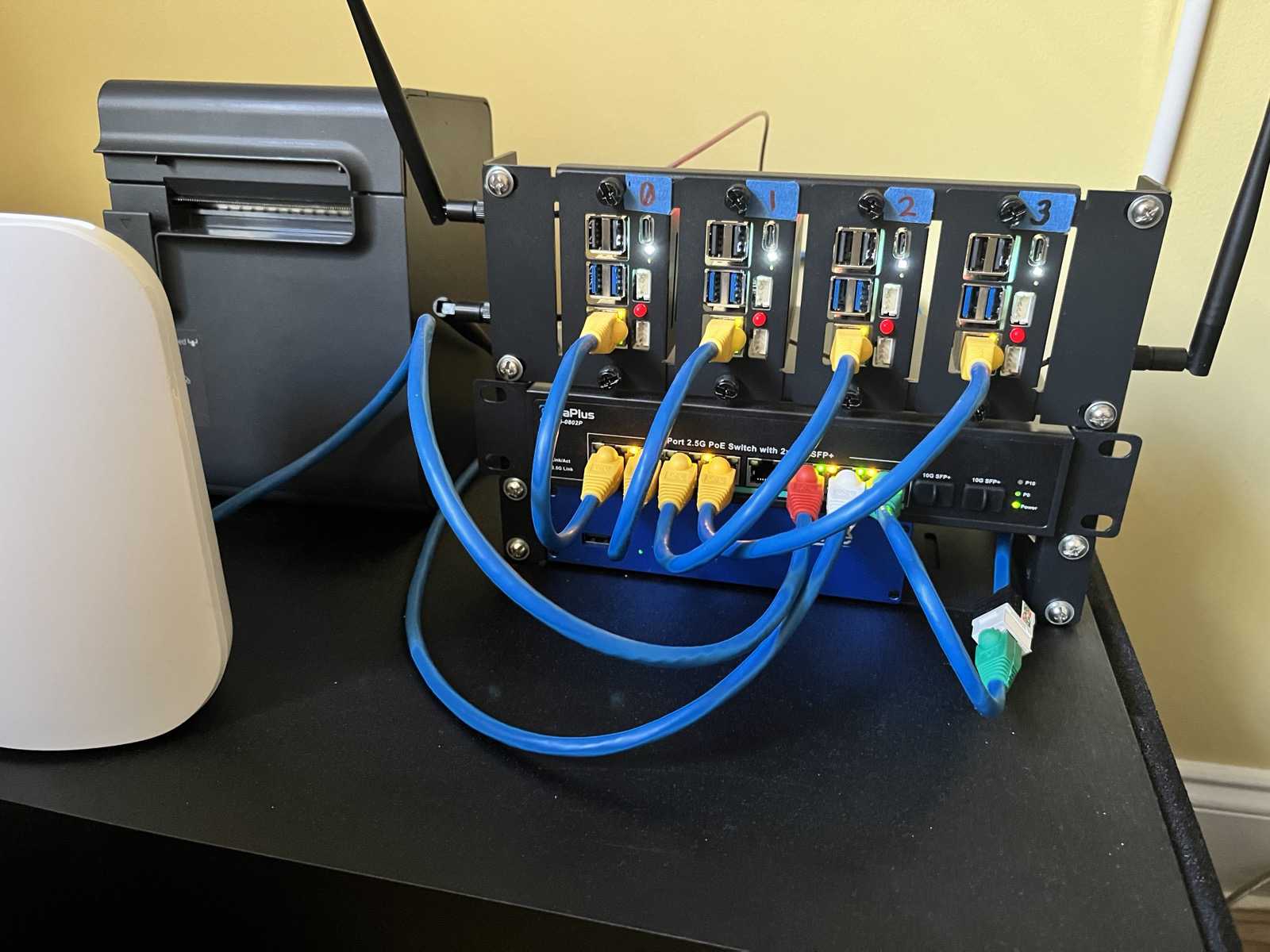
It contains:
- an OpenWRT One network router (an open-source hardware and software design!)
- four Raspberry Pi5 computers, each with NVME SSDs.
- a PoE-enabled ethernet switch that powers everything (through the ethernets) from a single wall-plug.
Those four computers are running a few pieces of software at all times (called “servers”). It’s my own private intranet, similar to what a lot of corporate jobs have. Basically: I run a bunch of websites that can only be accessed by certain approved devices, and only while connected to the home network (caveat: one of my servers is called wireguard, which gives me secure remote access).
On those same four computers, I also run a couple of public servers, like the blog you’re reading now. So how is that built? Well, the footer says:
Self-Hosted on Gitea with Git-Pages | Built with Hugo using Archie Theme
“Self-hosted” means when you type “blog.wbarlow.me” in your browser, your browser connects to my smolrack. Not to Google or Amazon or Microsoft, but my computer2 in my house3. If there’s a power outage at home, my site won’t load.
The “Gitea” and “Git-Pages” part describe the servers I’m running. There’s a popular website for software developers called GitHub, and they have a system for publishing websites that’s really easy to use. Unfortunately, GitHub is one of those centralized corporately-controlled services I’m trying to cut. Fortunately, though, the open-source community has developed some systems that function very similary. Gitea and Git-Pages are the ones I’ve chosen to use.
The “Hugo” and “Archie Theme” parts describe the tools I use on the authorship side (instead of the hosting side). When I write my posts, I’m not editing website code directly. Instead, I write my posts in a simpler text editing format (markdown syntax) and I use tools to “convert” that into website code. The tool I’ve chosen is called Hugo, and the minimalist theme you see is called Archie. Once the code is converted, it gets pushed to my servers automatically.
-
Yes, I know it should be “blog”. That’s a joke from a very old webcomic. ↩︎
-
Technically, I’ve put a third-party DNS proxy in the middle. This is for my protection (from hackers). ↩︎
-
Well, the North Carolina house (for now). ↩︎